Performance Management System at Blue Cross Blue Shield
5 MIN. READ
Body
Updated June 2019
Jennifer Atkins, Vice President, Network Solutions, Blue Cross Blue Shield Association
A good way to think about high-performance networks is similar to the way you think about your employees. If you were hiring a new employee, how would you identify a high-performing candidate during the interview process? Would you simply hire the candidate willing to work for you at the lowest rate? Probably not. You are likely to be more interested in a competitive candidate who has a proven track record of delivering the best results.
The same holds true in healthcare when defining a high-performance network. All too often, provider networks are labeled "high performance" when they are structured solely based on the lowest cost. That's like building your whole company by hiring the cheapest employees you can find. Sure your overhead might be low, but by sacrificing quality, you end up paying more in the long run.
Given that managing healthcare cost is a top priority for many employers, it's not surprising that high-performance networks are gaining a great deal of attention. To make the right decision for your business, you should have a clear understanding of what high-performance networks are— and what they aren't.
What is a high-performance network?
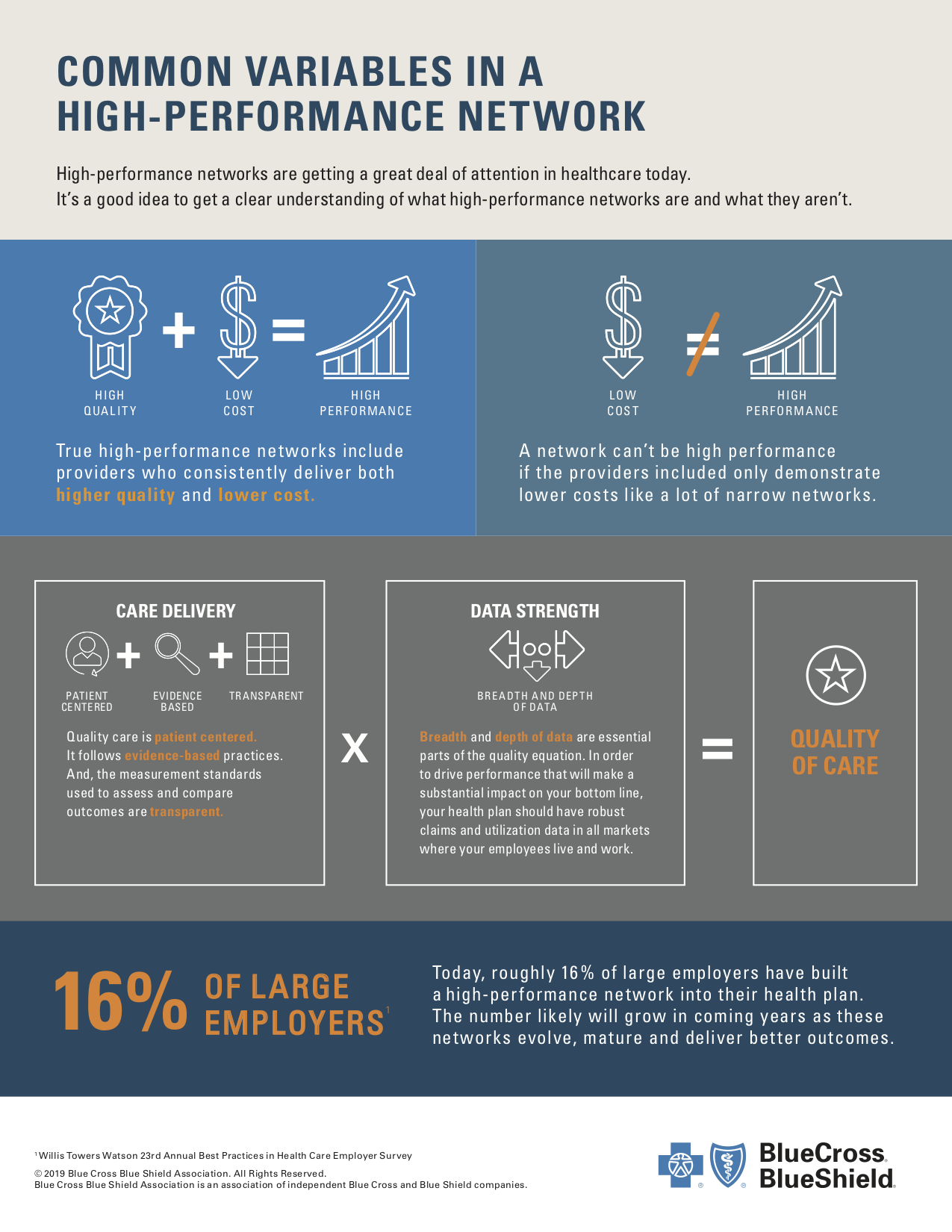
Download above infographic here.
High-performance networks deliver lower costs and higher quality
A network that only includes providers demonstrating lower costs, like a lot of narrow networks, is not a high-performance network. Providers in a true high-performance network consistently deliver both lower costs and higher quality through care that is patient-centered, evidence-based, appropriate and coordinated. Robust data-sharing and effective quality measurement play a critical role, as well, in identifying providers delivering quality care at a lower cost. Quality standards for the network should be well-defined, rigorous, and derived from sufficient data in order to drive performance delivering quality outcomes and making a substantial impact on healthcare spend.
Adoption of high-performance networks is growing
Today, roughly 16% of larger employers have built a "high-performance" network into their health plan1 . This number is projected to grow in the coming years as these networks evolve and mature. However, given that not all high-performance networks are created equal, it's important that you ask your health plan partner how quality and cost measures are factored into any high-performance network you are considering for your organization.
Identifying your high-performance network
Identifying high performance is ultimately more about getting a positive long-term return on your investment—and that's true whether you are hiring staff or choosing health benefit networks. Is there a proven track record of success? Is the rate competitive? Are you likely to get the results you are looking for? And most importantly, will you be happy with your decision in the long run? In order to identify a true high-performing option, the answer has to be yes for all.
1. Willis Towers Watson 23rd Annual Best Practices in Health Care Employer Survey
 Jennifer Atkins is vice president, network solutions for the Blue Cross Blue Shield Association (BCBSA), a national federation of 36 independent, community-based and locally operated Blue Cross and Blue Shield (BCBS) companies. Today, one-in-three Americans are covered by the BCBS system.
Atkins is responsible for all of BCBSA's national network solutions, including the Blue Distinction portfolio of high-performance networks.
Most recently Atkins was regional vice president of provider solutions at Anthem Blue Cross and Blue Shield in Wisconsin, with accountability for statewide provider contracting, network development and strategy. Prior to that she spent 10 years at Mercy Health, a Catholic healthcare ministry serving Ohio and Kentucky.
Atkins is also committed to working with various charitable organizations; she currently serves on the board as vice president of Hope House, a nonprofit shelter and community center located on the near south side of Milwaukee. Previously, she was on the board of FOCUS / Beach House, a Toledo, Ohio organization dedicated to resolving the root causes of homelessness and on the board of the YWCA of Toledo. She has also been active in the Boy Scouts of America and the National Forensics League.
Atkins earned an M.B.A. with an emphasis in finance from the University of Toledo and a bachelor's degree in history and English from Bowling Green State University.
Source: https://www.bcbs.com/smarter-better-healthcare/article/defining-high-performance-networks
0 Response to "Performance Management System at Blue Cross Blue Shield"
Post a Comment